
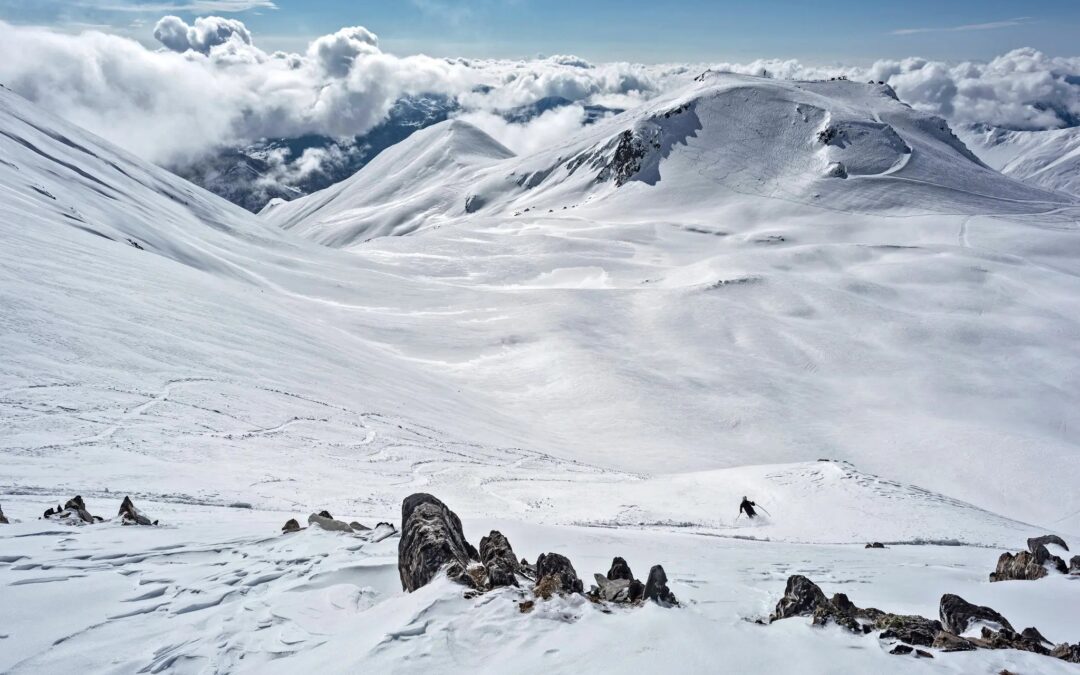
The Caucasus Mountain Range is a major mountain system in Eurasia, stretching between the Black Sea and the Caspian Sea. It forms a natural barrier between Eastern Europe and Western Asia and is known for its diverse geography, rich history, and cultural significance. The range is divided into two main parts:
Greater Caucasus
- Geography: The Greater Caucasus runs west to east, extending from the Black Sea to the Caspian Sea.
- Highest Peaks:
- Mount Elbrus: At 5,642 meters (18,510 feet), it is the highest peak in the Caucasus and Europe.
- Dykh-Tau: The second-highest peak in the Caucasus at 5,205 meters (17,077 feet).
- Shkhara: The highest peak in Georgia, standing at 5,201 meters (17,059 feet).
- Countries: It spans across several countries, including Russia, Georgia, and Azerbaijan.
Lesser Caucasus
- Geography: The Lesser Caucasus lies to the south of the Greater Caucasus, running parallel to it.
- Highest Peaks:
- Mount Aragats: The highest peak in Armenia, at 4,090 meters (13,419 feet).
- Mount Kaputjugh: One of the notable peaks in this range.
- Countries: This range stretches through parts of Armenia, Georgia, Azerbaijan, and Turkey.
Key Features
- Diversity: The Caucasus region is known for its incredible biodiversity and varied landscapes, including glaciers, alpine meadows, forests, and semi-arid regions.
- Cultural Richness: The region is home to many different ethnic groups and languages, reflecting its long history as a crossroads of various civilizations and empires.
- Mountaineering and Tourism: The mountains attract climbers, hikers, and tourists. Popular activities include trekking, skiing, and mountaineering, especially around Mount Elbrus and other high peaks.
Notable Locations
- Svaneti: A historic region in Georgia known for its picturesque villages, ancient towers, and beautiful landscapes.
- Sochi: A resort city in Russia, located on the Black Sea coast and known for hosting the 2014 Winter Olympics.
The Caucasus Mountains offer a blend of natural beauty, cultural heritage, and opportunities for adventure, making them a fascinating destination for travelers and outdoor enthusiasts.
The Caucasus region is divided into the South Caucasus and the North Caucasus, each encompassing several countries and territories. Here are the countries in the Caucasus:
South Caucasus (also known as Transcaucasia)
- Georgia: A country at the intersection of Europe and Asia, known for its diverse landscapes and rich cultural heritage. Key regions include:
- Abkhazia (a breakaway region recognized by some countries as independent)
- Adjara (an autonomous republic within Georgia)
- South Ossetia (a breakaway region recognized by some countries as independent)
- Armenia: A landlocked country with a rich history and cultural heritage. It is known for its ancient monasteries and mountainous terrain.
- Azerbaijan: Located on the Caspian Sea, it is known for its oil resources, modern capital Baku, and diverse geography. Key regions include:
- Nakhchivan (an autonomous exclave separated from the rest of Azerbaijan)
- Nagorno-Karabakh (a disputed region with a predominantly ethnic Armenian population that declared independence as the Republic of Artsakh, though it is not widely recognized and is internationally considered part of Azerbaijan)
North Caucasus
The North Caucasus is part of the Russian Federation and includes several republics, each with its unique ethnic composition and cultural identity:
- Dagestan
- Chechnya
- Ingushetia
- North Ossetia-Alania
- Kabardino-Balkaria
- Karachay-Cherkessia
- Stavropol Krai (a federal subject that includes part of the North Caucasus)
The North Caucasus is known for its complex ethnic makeup and history of conflict, but it also offers stunning natural beauty and cultural diversity.
These countries and territories collectively make the Caucasus region a unique and diverse area, rich in history, culture, and natural landscapes.